A - B - C - D - E- F - G - H - I-J-K - L - M - N-O - P - Q - R - S - T-U - V-W - X-Y-Z
Fisher, Irving ( 1867-1947 )
Nace en Saugerties, New York el 27 de febrero de 1867. Se gradúa y doctora en Yale University (B.A., 1888; Ph.D., 1891), donde trabaja como instructor in mathematics (1890-91), tutor in mathematics (1891-93), assistant professor of mathematics (1893-95), assistant professor of political and social science (1895-98), professor of political economy (1898-1935), y professor emeritus (1935-47).
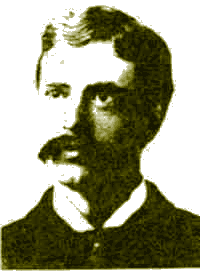 realizó aportaciones muy abundantes y originales a la ciencia económica. Propuso las curvas de indiferencia como método de análisis. Introdujo la distinción clave entre flujos y stocks. Elaboró unos modelos mecánicos basados en depósitos de agua, bombas y tubos, para simular la circulación económica y financiera. Ayudó a dar a conocer a la Escuela Austríaca en el mundo anglosajón y defendió la necesidad de mantener un coeficiente de caja bancario del 100% para evitar las crisis. Sin embargo fue también un gran defensor de la teoría cuantitativa del dinero. Su prestigio decayó bruscamente cuando, un par de días antes del crack de 1929, publicó un artículo opinando que la bolsa había alcanzado un "high plateau" del que nunca volvería a bajar.
En el campo de la estadística destaca su libro de 1922 sobre números índices, en el que propone lo que actualmente se conoce como "el índice de Fischer" que es una media de los índices de Laspeyres y de Paasche.
Fisher escribió numerosos artículos sobre matemáticas, política económica, tuberculosis, dieta y salud pública. Fue asesor presidencial y murió en New Haven, Conneticut, el 19 de abril de 1947.
OBRAS
- Mathematical Investigations in the Theory of Value and Prices, 1892.
- Appreciation and Interest, 1896.
- "The Role of Capital in Economic Theory", 1897, EJ.
- "Precedents for Definining Capital" , 1898, QJE.
- The Nature of Capital and Income, 1906.
- The Rate of Interest, 1907.
- National Vitality, its wastes and conservation, 1910.
- The Purchasing Power of Money: Its determination and relation to credit, interest and crises, 1911.
- Elementary Principles of Economics, 1912.
- "The Impatience Theory of Interest", 1913, AER.
- Why is the Dollar Shrinking? A study in the high cost of living, 1914.
- After the war, what? A plea for a league of peace. 1914.
- "Is "Utility" the Most Suitable Term for the Concept It is Used to Denote?", 1918, AER.
- "Economists in Public Service", 1919, AER.
- Stabilizing the Dollar, 1920.
- The Making of Index Numbers: A study of their varieties, tests and reliability, 1922.
- "The Statistical Relation Between Unemployment and Price Changes", 1926, International Labor Review
- Prohibition at its Worst, 1927.
- The Money Illusion, 1928.
- The Theory of Interest: As determined by the impatience to spend income and opportunity to invest it. , 1930.
- Booms and Depressions, 1932.
- "The Debt-Deflation Theory of Great Depressions", 1933, Econometrica.
- Inflation, 1933.
- Stamp Scrip, 1933.
- 100% Money, 1935.