A - B - C - D - E- F - G - H - I-J-K - L - M - N-O - P - Q - R - S - T-U - V-W - X-Y-Z
Buchanan, James M. ( 1919-2013 )
Premio Nobel 1986
1986
Economista norteamericano obtuvo el Premio Nobel de Economía en 1986 por su desarrollo de las bases contractuales y constitucionales de la teoría de la adopción de decisiones económicas y políticas.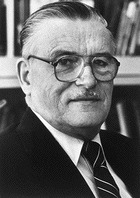
Buchanan, James M. estudió en las universidades de Tennessee y Chicago y ejerció la docencia en las de Pennsylvania y Virginia. Especialista en Hacienda Pública, realizó interesantes estudios sobre el papel de la inflación como impuesto y sobre la naturaleza de la Deuda Pública. Es líder y teórico de la corriente Public Choice que analiza la forma en que se adoptan las decisiones públicas que influyen en el funcionamiento del sistema económico.
Falleció en Blacksburg, Virginia, 9 de enero de 2013.
Textos en castellano de Buchanan incluidos en esta enciclopedia:
- Buchanan, James M. ¿Pueden los "estados benefactores" en democracia sobrevivir a las crisis financieras? (PDF)
- Buchanan, James M. Apatía del contribuyente, inercia institucional y crecimiento económico (PDF)
- Buchanan, James M. La deuda pública y la formación de capital (PDF)
- Buchanan, James M. ¿Qué deberían hacer los economistas? (PDF)
- Buchanan, James M. Ensayos sobre economía política
- Buchanan, James M. La perspectiva de elección pública
OBRAS
- "Individual Choice in Voting and the Market", 1954, JPE
- "Social Choice in Voting and the Market", 1954, JPE
- Public Principles of Public Debt, 1958.
- "Positive Economics, Welfare Economics and Political Economy", 1959, J Law Econ
- Fiscal Theory and Political Economy, 1960.
- "Externality", with W.C. Stubblebine, 1962, Economica
- The Calculus of Consent: Logical foundations for constitutional democracy, con G. Tullock, 1962.
- "What Should Economists Do?", 1964, Southern EJ
- "Ethical Rules, Expected Values and Large Numbers", 1965, Ethics
- "Economics and Its Scientific Neighbors", 1966, in Krupp, editor, Structure of Economic Science
- Public Finance in Democratic Process, 1967.
- Demand and Supply of Public Goods, 1968.
- "An Economist's Approach to Scientific Politics", 1968, in Parsons, editor, Perspectives in the Study of Politics.
- Cost and Choice: An inquiry into economic theory, 1969.
- "Is Economics the Science of Choice?", 1969, in Streissler, editor, Roads to Freedom
- "Notes for an Economic Theory of Socialism", 1970, Public Choice
- Academia in Anarchy, with N.Devletoglou, 1971.
- "Equality as Fact and Norm", 1971, Ethics
- "Before Public Choice", 1973, in Tullock, editor, Explorations in the Theory of Anarchy
- The Limits of Liberty: Between Anarchy and Leviathan, 1975.
- "Public Finance and Public Choice", 1975, National Tax Journal
- "A Contractarian Paradigm for Applying Economic Theory", 1975, AER
- "Barro on the Ricardian Equivalence Theorem", 1976, JPE
- "Methods and Morals in Economics", 1976, in Breit and Culbertson, editors, Science and Ceremony
- Democracy in Deficit: the political legacy of Lord Keynes, with R.E. Wagner, 1977.
- "Markets, States and the Extent of Morals", 1978, AER
- Freedom in Constitutional Contract, 1978.
- What Should Economists Do?, 1979.
- The Power to Tax: the analytical foundations of a fiscal constitution, with G. Brennan, 1980.
- "The Homogenization of Heterogeneous Inputs", with R.D. Tollison, 1981, AER
- "The Domain of Subjective Economics: Between predictive science and moral philosophy", 1982, in Kirzner, editor, Method, Process and Austrian Economics
- "Order Defined in the Process of Emergence", 1982, Literature of Liberty
- The Reason of Rules: constitutional political economy with G. Brennan, 1985.
- Liberty, Market and the State, 1986.
- Economics: between predictive science and moral philosophy, with G. Brennan, 1988.
- Explorations in Constitutional Economics, 1989.
- The Economics and Ethics of Constitutional Order, 1991.