A - B - C - D - E- F - G - H - I-J-K - L - M - N-O - P - Q - R - S - T-U - V-W - X-Y-Z
Krugman, Paul ( 1953- )
Premio Nobel  2008
2008
El premio del Banco Central de Suecia en memoria de Alfred Nobel 2008 ha sido concedido al Paul Krugman "por su análisis de las pautas de comercio y la localización de la actividad económica" destacando así su contribución a la teoría economía internacional y la geografía económica.
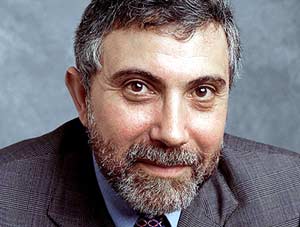 Doctorado por el MIT en 1977, ha sido profesor en Yale, Stanford, MIT y Princeton. Ha sido asesor económico del Presidente de los EEUU durante la administración Reagan. En 1991
recibió la medalla John Bates Clark que concede cada dos años la American Economic Association a un economista menor de 40 años. También recibió el Premio Príncipe de Asturias de Ciencias Sociales en el año 2004.
Doctorado por el MIT en 1977, ha sido profesor en Yale, Stanford, MIT y Princeton. Ha sido asesor económico del Presidente de los EEUU durante la administración Reagan. En 1991
recibió la medalla John Bates Clark que concede cada dos años la American Economic Association a un economista menor de 40 años. También recibió el Premio Príncipe de Asturias de Ciencias Sociales en el año 2004.
Es posiblemente el economista más popular de nuestra época ya que ha combinado su trabajo académico e investigador con el divulgativo. Publica habitualmente en The New York Times, en la revista Fortune "No Free Lunch" y en la revista electrónica Slate "The Dismal Science".
Sus investigaciones integran
el espacio en la teoría económica mediante la incorporación de
conceptos como mercados imperfectos, rendimientos a escala, los
efectos de la aglomeración y el progreso técnico en la formación
de modelos. Es considerado cofundador de la nueva teoría del
comercio exterior y de la New Economic Geography.
Considera que través de sucesivas integraciones económicas no se
alcanza necesariamente un aumento general del bienestar. Los
ganadores del comercio global son especialmente los países
industrializados, en tanto que los países en vías de desarrollo
pueden sacar pocas ventajas con la tendencia a la liberalización
del comercio. Esto es válido aún dentro de regiones o grandes
países donde surgen en centros urbanos industriales lugares de
producción altamente especializados que marcan de nuevo grandes
diferencias entre ganadores y perdedores.
En español
El Momento de la Verdad
Publicado en El País el 12 de octubre de 2008
Dinero a cambio de basura
Publicado en El País el 28 de septiembre de 2008
Página Personal
http://web.mit.edu/krugman/www/
http://www.pkarchive.org/
Ver también
Capítulo sobre Economía Internacional de su manual de Teoría Económica
Videos de Paul Krugman
Artículos
Fortune / No Free Lunch
The ice age cometh (5/25/98)
Supply, demand, and English food (7/20/98)
Why aren't we all Keynesians yet? (8/3/98)
Soros' plea (Nov. 1998)
The euro:beware of what you wish for (Dec. 1998)
I know what the hedges did last summer (Dec. 1998)
Should the Fed care about stock bubbles? (Mar. 1, 1999)
THAT CERTAIN JE NE SAIS QUOI OF LES ANGLOPHONES (April 1999)
The ascent of e-man (May 1999)
What you don't think about can't hurt you
Why Germany Kant Kompete (July 1999)
A self-defeating prophecy (Dec. 1999)
Slate Magazine/The Dismal Science
Downsizing downsizing
(6/24/96)
How copper came a cropper
(7/15/96)
Supply-side virus strikes
again (8/15/96)
The lost fig leaf
(9/27/96)
Economic culture wars
(10/24/96)
Gold bug variations
(11/22/96)
The CPI and the rat race
(12/21/96)
The accidental theorist
(1/23/97)
Vulgar Keynesians
(2/6/97)
In praise of cheap labor
(3/20/97)
Earth in the balance sheet
(4/17/97)
Rat democracy (5/15/97)
Unmitigated Gauls
(6/5/97)
The east is in the red
(7/1/97)
Bahtulism (8/14/97)
Who's buying whom?
(9/25/97)
The power of biobabble
(10/23/97)
A raspberry for free trade
(11/20/97)
Speed trap(12/18/97)
The legend of Arthur
(1/14/98)
Entertainment values
(1/22/98)
Krugman's Life of
Brian (A Symposium) (1/30/98) (because it contains letters from other people,
this requires a subscription to Slate - try it, you'll like it)
Algorithms (2/12/98)
Paradigms of panic
(3/12/98)
The $300,000 man
(4/11/98)
Soft microeconomicsThe
squishy case against you-know-who (4/23/98)
Glenn Loury's Round Trip
The odyssey of a black intellectual
Setting sunJapan:
What went wrong? (6/11/98)
Size does matterIn
defense of macroeconomics (7/9/98) (requires Slate subscription)
Baby-sitting the
economy (8/13/98) (requires Slate subscription)
The other bear market
(9/10/98) (requires Slate subscription)
Rashomon in
Connecticut
Is the economic crisis
a crisis for economics ? (11/12/98)
The hangover theory
(12/3/98)
No pain, no gain?
(1/14/99)
Morning in Japan?
(3/11/99)
Monomoney mania
(4/15/99)
Thinking outside
the box office (5/12/99)
When good things
happen to bad ideas (6/9/99)
Don't laugh at
me, Argentina (7/20/99)
Talking about a
revolution (8/19/99)
Capital control
freaks (9/28/99)
O Canada (the
latest Nobel prize)
Tiger's tale
Enemies of the
WTO
Otros escritos divulgativos
En New York Times:
Gordon Does Good
With stunning speed, the British government defined the character of the worldwide rescue effort. Now other wealthy nations have to catch-up.
October 13, 2008Moment of Truth
If a new rescue plan is not announced this weekend, the world economy may experience its worst slump since the Great Depression.
October 10, 2008Health Care Destruction
Republicans still hate Medicare and have not been able to kill it. Since that is out, John McCain is going after insurance of nonelderly Americans instead.
October 6, 2008Edge of the Abyss
The financial news since the middle of last month has been grim. And what's truly scary is that we're entering a period of severe crisis with weak, confused leadership.
October 3, 2008The 3 A.M. Call
The next president will likely have to deal with some major financial emergencies. Barack Obama seems well informed. John McCain, on the other hand, scares me.
September 29, 2008Where Are the Grown-Ups?
The grown-up thing to do is to rescue the financial system. If Henry Paulson isn't the grown-up we need, are Congressional leaders able to fill the role?
September 26, 2008Cash for Trash
Henry Paulson is demanding extraordinary power for himself to deploy taxpayers' money on behalf of a plan that, as far as I can see, doesn't make sense.
September 22, 2008Crisis Endgame
Faced with the financial crisis spinning out of control, much of Washington appears to have decided that government isn't the problem, it's the solution.
September 19, 2008Financial Russian Roulette
If institutions need to be rescued like banks, they should be regulated like banks why were we so unprepared for this latest shock?
September 15, 2008Blizzard of Lies
Anyone with an Internet connection can disprove many assertions of the McCain campaign.
An exchange with Jude Wanniski
(from Mother Jones backtalk)
" Ricardo's difficult
idea " (paper for Manchester conference on free trade, March 1996)
" What economists can
learn from evolutionary theorists " (a talk to the EAEPE, Nov. 1996)
" Against the tide: an
intellectual history of free trade " (book review)
" What should trade
negotiators negotiate about? " (review essay in Journal of Economic
Literature, March 1997)
" Seeking the rule of
the waves " (book review, Foreign Affairs, June 1997)
" One world, ready or
not " (book review, The Washington Post)
" What is wrong with
Japan? " (Nihon Keizai Shimbun)
" How fast can the
U.S. economy grow? " (Harvard Business Review, Summer 1997)
" Capitalism's
mysterious triumph " (Nihon Keizai Shimbun)
" Is capitalism too
productive? " (Foreign Affairs, Sept./Oct. 1997)
" What ever happened
to the Asian miracle? " (Fortune, Aug. 18, 1997)
" Currency crises
" (prepared for NBER conference, October 1997)
" Two cheers for
formalism " (forthcoming in Economic Journal)
" The Mercedes
menace " (USA Today, Jan. 13, 1998)
" The trouble with history
" (Washington Monthly, March 1998)
" Will Asia bounce
back? " (speech to be given in Hong Kong, March 1998)
"Start taking the Prozac
" (Financial Times, April 9, 1998)
" I told you so
" (New York Times Magazine, May 5, 1998)
" The myth of Asia's
miracle " (the Nov. 1994 Foreign Affairs article - by popular demand)
" Future
imperfect " (The Red Herring, June 1998)
America the Boastful (Foreign
Affairs, May 1998)
The Great Betrayal (Washington
Post - review of Patrick Buchanan)
A bridge to nowhere? (Shizuoka
Shimbun, 7/14/98)
False Dawn : The Delusions of
Global Capitalism (book review, New Statesman)
No time for losers (New
York Times Magazine, 7/26/98)
Viagra and the wealth of
nations (New York Times Magazine, 8/23/98)
Don't panic - yet (New
York Times, 8/30/98)
An open letter to Prime
Minster Mahathir (9/1/98)
The
confidence game (The New Republic, 10/5/98)
Heresy time (9/28/98 - a
note on why I have starting saying outrageous things)
Curfews on capital: what
are the options? (10/12/98 - why dollar debt is not the problem)
The eternal triangle
(10/13/98 - a note on global "architecture")
Even worse than you think
(10/27/98) Financial Times
The return of Dr. Mabuse
(New York Times Magazine)
The web gets ugly (New
York Times Magazine, Dec. 6, 1998)
Japan heads for the
edge (Financial Times, 1/20/99)
Alas, Brazil
(2/1/99)
Syllabus for graduate
macro
A monetary fable (The
Independent)
Delusions of
respectability (2/7/99)
Inflation targeting
in a liquidity trap: the law of the excluded middle (2/10/99)
Some chaotic notes on
regional dynamics (3/10/99)
Labor pains (The
New York Times Magazine, 5/23/99)
Still depressed
about Japan (Financial Times)
Global vision du jour
(Washington Monthly)
Money can't buy
happiness - er, can it? (New York Times)
The euro, living
dangerously (A quick note after reading the news)
Recovery?
Don't bet on it (Time, Asia edition)
A dollar crisis?
(memo, August 1)
Why I am an economist
(sigh) (Notes during textbook revision)
Land of the rising
yen
Pathetic is the word
Networks and
increasing returns: a cautionary tale
Dow 36,000: how silly
is it?
The wonders of editing
Notes on Social
Security
Class warfore?
Escritos de carácter científico
" What happened to
Asia? " (for a conference in Japan, January 1998)
" Fire-sale FDI
" (for NBER Conference on Capital Flows to Emerging Markets, Feb. 20-21,
1998)
" Japan's trap
" (May 1998: an attempt to clarify my own thoughts on the Japanese slump)
Further notes on Japan's
liquidity trap (clarification on "Japan's trap")
But for, as if, and so what
(a technical note on the effect of trade on wages)
Latin America's swan song
(notes on the current dilemma)
It's baaack! Japan's slump
and the return of the liquidity trap (draft Brookings Paper - requires
Adobe Acrobat)
Japan's bank bailout
(10/17/98 - why the scheme is likely to fail)
Japan: still trapped
(11/30/98 - a restatement of the argument)
There's something about
macro (notes about teaching graduate macroeconomics)
The world's
smallest macroeconomic model
Balance sheets, the
transfer problem, and financial crises (pdf file, rough draft of conference
paper)
Can deflation be
prevented? (2/21/99)
Deflationary spirals
(2/25/99)
The spatial economy:
introduction (introduction to forthcoming book with Masahisa Fujita and
Anthony J. Venables)
The fall and rise of
development economics (a 1994 essay about models and methods from
Rodwin and Schon, Rethinking the Development Experience)
Heaven is a weak
euro (6/3/99)
And now for something
completely different (Paper presented at a 1998 conference on trade and
inequality)
Analytical
afterthoughts on the Asian crisis (9/12/99)
Time on the cross: can
fiscal policy save Japan? (9/21/99)
Was it all in Ohlin?
(paper for Centennial celebration of Bertil Ohlin, Stockholm)
Thinking about the
liquidity trap (paper for NBER/CEPR/TCER conference in Tokyo, Dec. 1999)
The energy crisis
revisited (note posted Mar. 5, 2000)